
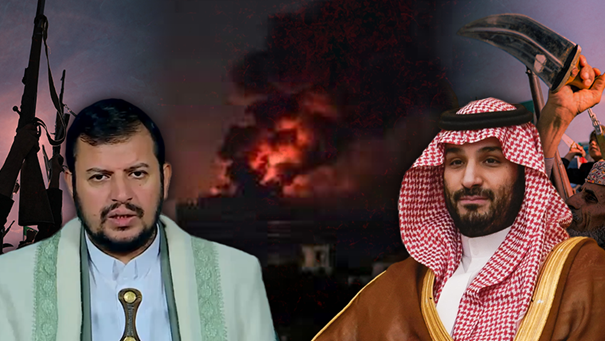
Even as Americans commemorate the pain of the September 11 attacks, at the same time, the Houthis of Yemen, under coordination along the “axis of resistance,” are taking absolute control of the Bab el-Mandeb Strait and the entire Yemeni coast of the Red Sea.
On Friday, September 11, 18 hours of warfare were enough to reshape a decades-old maritime architecture. The Houthis seized Mokha, Hays, Dhubab, then Murad, then Mayyoun Island (also known as Perim Island), then the Hanish Islands (Greater Hanish, Lesser Hanish, and Zuqar ) – this volcanic rock that divides the channel into two navigable passes and which, for a century, has restricted all freedom of movement between the Red Sea and the Gulf of Aden. “Everything that was under our control on the western coast has fallen,” a Yemeni official admitted to AFP. The military euphemism barely conceals the scale of the collapse: this is not a tactical retreat; it is a complete breakdown of the defenses.
Washington contemplates its military impotence. Europe watches in stunned silence as its maritime supply chains crumble
For the first time in its history, a non-state actor exercises continuous control over the entire Yemeni Red Sea coastline, extending to the 28-kilometer strait through which 12 to 15% of global trade once passed. In naval doctrine, this would be called a “total access denial” capability at a critical global chokepoint. In plain language: the Houthis no longer need to strike a ship to force it to abandon its voyage. Their mere presence is enough to dictate the risk.
The reality of maritime control
Bab el-Mandeb has changed hands. The geopolitics of the Strait have collapsed under the blows of Ansar Allah. The Houthis are no longer content with disrupting commercial shipping; they now impose undisputed sovereignty over the entire Yemeni Red Sea coastline. This geostrategic reality brutally slaps Riyadh’s certainties and Western illusions of security. The Saudi empire/kingdom, armed with tens of billions of dollars’ worth of American technology, finds itself paralyzed by a disciplined militia wielding ruthless asymmetric warfare. The illusion of Saudi air superiority has been shattered on the reefs of Al-Hudaydah. Washington contemplates its military impotence. Europe watches in stunned silence as its maritime supply chains crumble.
Economic asphyxiation and the failure of the oil pipeline
The figures don’t lie. Commercial traffic through the Suez Canal has collapsed by more than 75% in just a few months. The vital artery of global trade is now a ghost waterway. To bypass Bab el-Mandeb, ships now sail around Africa via the Cape of Good Hope. This adds ten to fifteen days to the crossing, skyrockets freight costs, and multiplies the carbon footprint of Western fleets. The Suez Canal is virtually dead, rendered logistically obsolete by drone strikes and cheap anti-ship ballistic missiles, and the Houthi takeover of the entire Yemeni coastline now threatens to erase it completely. Egypt is thus losing its foreign exchange earnings. The European Union is accumulating inflationary supply shocks. This imported logistical inflation is something Brussels is deliberately avoiding quantifying, for fear of admitting its dependence on a route it no longer controls. As for Saudi oil, the avoidance strategy of using the East-West pipeline to the port of Yanbu on the Red Sea has been a complete failure. The recent strikes on the Yanbu terminal, launched from Iraqi territory and confirmed by the Saudi Ministry of Energy, have reduced this temporary alternative to ashes, thus consecrating the victory of the “axis of resistance.” The Saudi economy is now caught in a vice, on the verge of collapse.
The failure of alliances: American abandonment and Pakistani desertion
Riyadh believed it could take refuge behind American military power and regional pacts, notably the Trilateral Treaty of Mecca with Pakistan and Turkey. This is far from the truth. Donald Trump’s posturing reveals an irreparable strategic rift. Anxious to avoid an uncontrollable spiral and reluctant to commit US Navy resources to a bottomless pit, Washington refuses to carry out the massive strikes demanded by the Saudi Crown Prince, Mohammed bin Salman, affectionately known to the West as MBS. American rhetoric evaporates as soon as it comes to confronting a naval war of attrition with a prohibitive cost, despite the 1945 Quincy Agreement. This is a signal understood by all regional actors, including Tehran, indicating that the American guarantee, a pillar of the Gulf oil order for 80 years, is now negotiable. For its part, Islamabad is putting on a show of polite desertion. The famous Mecca Pact, signed last August with great fanfare to seal the strategic and security alliance between Pakistan (the only Islamic nuclear power), Turkey (a NATO member), and Saudi Arabia, has proven to be an empty shell. Islamabad categorically refuses to send its troops or commit its air force to the Yemeni front. Riyadh finds itself alone, exposed, and ridiculed before the Arab world.
Riyadh is paradoxically discovering that a paper pact cannot replace an oil supply chain. The symbolism is bitter: this treaty, signed in the holiest city of Sunni Islam, was supposed to embody strategic autonomy from Washington. A month later, neither Ankara nor Islamabad has lifted a finger for Riyadh. The proclaimed autonomy, in practice, looks like a mere redistribution of dependence.
The Houthis’ show of force has thus revealed the illusory nature of NATO, both Islamic and Sunni. The 8,000 Pakistani soldiers deployed on Saudi soil in the spring remain a static totem, never activated as a power projection force. Saudi Arabia is thus discovering the extreme isolation of dependent regimes. The American protectorate proves to be a sham, and alliances based on financial gain dissipate as soon as they are tested by fire.
The Western naval doctrinal debacle in the face of asymmetry
The Houthis’ tactical agility has outmatched the conventional military doctrines of NATO powers. Their combined use of low-cost reconnaissance drones, explosive autonomous boats, and locally manufactured hypersonic missiles has sealed off access to the Red Sea. No international naval coalition has been able to restore freedom of navigation. Western technological superiority has run up against a permanent asymmetric saturation. US aircraft carriers must move away to avoid saturation fire. The Saudi and Emirati regimes watch in horror as their critical infrastructure becomes utterly vulnerable. The Saudi crown prince’s Vision 2030 project, based on attracting foreign investment and developing coastal tourism, is collapsing under the weight of maximum security risk. Futuristic megacities cannot be built within range of ballistic missiles.
The future possibilities and the new regional order
The potential future consequences of this shift are devastating for the West and the Saudi monarchy. The Houthi regime’s continued control over Bab el-Mandeb Strait solidifies the redistribution of security power in the Middle East. The axis of resistance validates the viability of a low-cost maritime access denial strategy against a coalition theorized as invincible. Saudi Arabia is effectively under economic siege: its gross exports are threatened, its maritime insurance costs skyrocket, and its reputation as a regional power is definitively destroyed. Europe, unable to project a credible naval force without American tutelage, will suffer a lasting decline in its industrial competitiveness. Trump’s America is de facto demonstrating its pragmatic disengagement, abandoning its historical allies at the first serious challenge. The Bab el-Mandeb Strait has become the graveyard of Saudi hegemonic ambitions and Western arrogance.
Three scenarios are emerging, and none is painless. A risk premium permanently embedded in the price of Saudi crude, further straining a Vision 2030 already weakened by falling prices and the cost of its megaprojects. A Europe forced to choose between accepted logistical overruns and acknowledged strategic dependence – though no capital has yet dared to tell its public. Finally, a redefinition of the regional security architecture: if the American guarantee falters and the Sunni pacts prove hollow under pressure, Riyadh will have only two options – negotiate from a position of weakness with Tehran, or finally build an independent deterrent, something it has historically never had to construct alone.
We therefore conclude that, since 1869, Western power has been built on the assumption that strategic maritime routes would ultimately remain under Western control or protection. Bab el-Mandeb in 2026, like Hormuz before it, demonstrates the opposite: a poorly equipped non-state actor can freeze a global flow of goods without possessing a single frigate. Traditional deterrence – aircraft carriers, sanctions, bellicose rhetoric – is ineffective against an adversary that has no territory to lose and therefore nothing to negotiate.
Bab el-Mandeb is no longer just a strait. It’s a verdict. And this verdict says that a power that no longer controls its routes will soon control nothing.
*The author is expert in the geopolitics of governance and regional integration, Institute of Governance, Human and Social Sciences, Pan-African University
